


Alberta’s proposed new oil pipeline would be built along a southern route to the B.C. coast through a partnership with Trans Mountain Corporation and Pembina Pipeline Corporation.
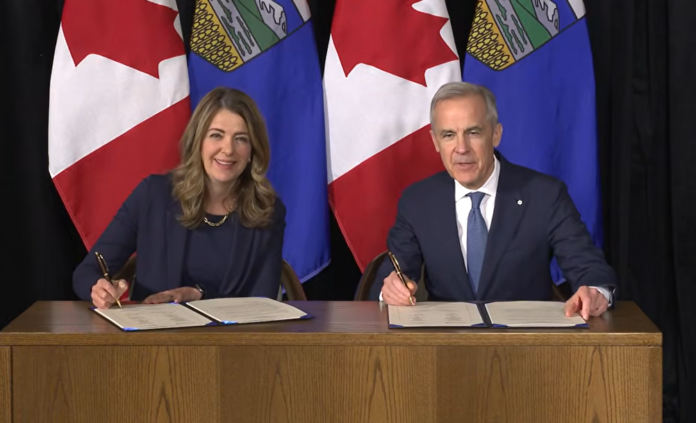
Alberta Premier Danielle Smith presented details of the proposal on Thursday, alongside Prime Minister Mark Carney in Calgary.
Canada and Alberta would be equal partners in the project, with an equity stake reserved for Indigenous communities.
The federal government said the development would be led by Trans Mountain, while Pembina would act as a private-sector investor and contribute its expertise to the development.
Smith said the question of how much of the joint venture project would be privately funded and how much would be funded by the provincial and federal governments remained to be negotiated.
The route would follow the existing Trans Mountain pipeline corridor.
Smith said a southern route from Bruderheim, Alta., to a deep-water port terminal on B.C.’s southwest coast would be the fastest, most cost-effective path.
Selecting a southern route for the pipeline would also sidestep some objections from B.C. officials and coastal First Nations, who were staunchly opposed to lifting a federal ban on oil tankers off B.C.’s north coast.
Smith said the pipeline would transport more than one million barrels of oil per day to B.C.’s west coast.
Carney said he would immediately refer the plan to the federal Major Projects Office (MPO) for potential fast-tracking.
He said consultations with First Nations, provinces and other stakeholders would begin right away, with a decision from the MPO due by Oct. 1.
If the MPO deems the pipeline a project of national interest, it would go through a streamlined federal permitting process.
“There is no doubt in my mind that this is a project of national interest, one that will help connect Alberta oil to global markets and strengthen our country’s economic future for decades,” said Smith.
An agreement signed by Alberta and Ottawa in May said construction could begin as soon as September 2027, following Indigenous consultations and if all approvals and permits are in place.
Smith said Alberta is meanwhile working to finalize another agreement with the federal government and a group of five major oil companies to expand oilsands production and advance the proposed Pathways carbon capture and storage project.
Carney said the pipeline and Pathways Project together would generate more than $200 billion in new direct investments in Canada and create at least 175,000 new jobs.

Carney was in Vancouver earlier on Thursday to announce a major agreement between Ottawa and B.C. that included support for major projects in the province.
The deal said that while B.C. does not seek a new pipeline, it would participate in good faith with necessary routing and permitting discussions, as long as Ottawa follows through on commitments to maintain the tanker ban and engage meaningfully with First Nations.
Canada and B.C. would also negotiate a framework for the province to get a share in the profits from the pipeline project, which could include annual royalty payments by the pipeline operator.