

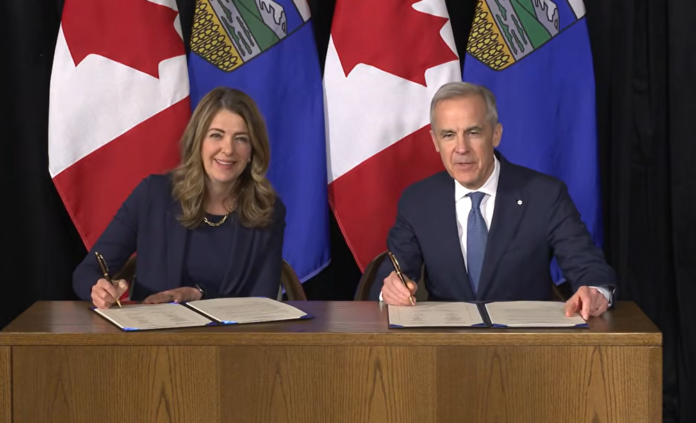

Canadian Prime Minister Mark Carney and Alberta Premier Danielle Smith signed a memorandum of understanding intended to pave the way for the design, and potentially start of construction of a new oil pipeline to Asian markets as early as Sept 1. 2027.
The two governments said the deal would also prevent a planned increase in the federal industrial carbon price, which Alberta estimates would save industry about $250 billion by 2050.
Premier Danielle Smith said the agreement signals Alberta and Canada are committed to expanding market access and building major infrastructure projects.
“This agreement sends a clear message to investors and global partners that Canada and Alberta are serious about expanding market access, building major infrastructure and creating the conditions for long-term investment in our province’s energy sector,” Smith said.
Prime Minister Mark Carney said the agreement is intended to create a more streamlined project approval process.
“Today’s agreement reinforces that Alberta and Canada are lands where the opportunities are plentiful, the rules are clear, and one project means one review,” Carney said.
Under the agreement, the federal government would expedite review of Alberta’s proposal for a west coast pipeline through the federal Major Projects Office, with the goal of designating it a project of national interest by Oct. 1, 2026.
The proposed Indigenous co-owned pipeline would transport more than one million barrels of oil per day to Asian markets through a west coast export terminal.
Both governments said they remain committed to consulting with Indigenous communities and supporting opportunities for Indigenous ownership and partnerships tied to the project.
The agreement also outlines a revised industrial carbon pricing framework. The industrial carbon price would remain at $95 per tonne through 2026, rise to $100 per tonne beginning in 2027 and increase to $130 per tonne by 2035.
The deal also includes commitments not to proceed with a federal oil and gas emissions cap, to suspend implementation of the federal Clean Electricity Regulations in Alberta and to streamline environmental review processes through a new impact assessment agreement.
The governments said they will also establish a joint electricity working group to examine low-emission technologies including nuclear, geothermal, hydrogen, wind, solar and natural gas with carbon capture.