

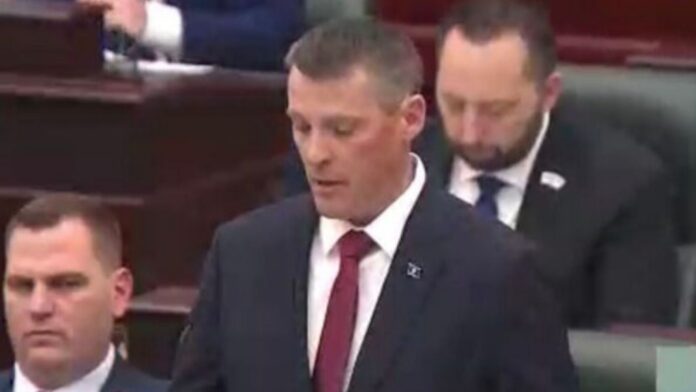

Alberta’s finance minister said the projected deficit in Budget 2026 reflects the current economic reality and rising service pressures, also is pushing the UCP government to review its fiscal rules.
Finance Minister Nate Horner said the budget he tabled in the legislature Thursday forecasts a $9.4-billion deficit in 2026-27, followed by projected shortfalls of $7.6 billion and $6.9 billion in the next two years, and acknowledged it is a tough pill to swallow.
“But we won’t sacrifice our public services to make our deficit disappear, and we aren’t raising personal income tax,” Horner said.
He said the province expects slower growth in 2026 amid U.S. tariffs, trade uncertainty and lower oil prices. Real GDP is forecast to rise 1.8 per cent this year, while West Texas Intermediate crude is projected to average US$60.50 per barrel — down from last year’s forecast of US$71. Horner said every US$1 drop in the oil price reduces Alberta’s bottom line by $680 million.
Projected revenue for 2026-27 is estimated at $74.6 billion, down more than $700 million from the previous third-quarter forecast, while expenses are projected at $83.9 billion, up $4.5 billion, including a $2-billion contingency for unforeseen costs such as natural disasters.
RELATED STORY: Healthcare, schools, infrastructure top Alberta’s $9.4B deficit budget
Horner defended the run of projected deficits, saying the government has kept operating spending growth within its population-plus-inflation cap, a key part of Alberta’s fiscal framework. He said the government has not broken the operational expense ceiling rule.
However, he acknowledged the budget exceeds another rule limiting the size of the deficit. Under the framework, the 2026-27 deficit would have been capped at $4.9 billion, but the projected shortfall is $4.5 billion higher.
“The technical piece around the size of the deficit, yes, we’re breaking it,” Horner said. “We will look at that rule with the team and likely amend it in the fall. There wasn’t time currently in this budget process.”
“I don’t want to just repeal them. I want to find some rules that continue to constrain us, but allow us the flexibility to do what Alberta needs.”
Horner said the consequences for breaking the fiscal framework are political.
“We created these rules, and I’m breaking them. So nobody it bothers more than it does me.”
He said the province’s heavy reliance on volatile resource revenue makes designing durable fiscal rules more complex than in other jurisdictions. He said Alberta has seen rapid population growth in recent years without a corresponding surge in economic growth, increasing pressure on schools, hospitals and infrastructure.
“Everything that we know now is in this budget and in the out-year, so we don’t see a path currently.”
“That means the work isn’t done and we’re talking about either finding ways to create more revenue, finding ways to cut expense or running deficits.”
The budget projects no new contributions to the Heritage Savings Trust Fund over the next three years, though Horner said the fund — now about $30 billion — will continue to grow by retaining investment earnings. The government’s goal remains to grow the fund to $250 billion by 2050.
Taxpayer-supported debt is forecast to push net debt-to-GDP to 10.5 per cent by March 31, 2027, rising to 12.9 per cent in later years. Horner said Alberta remains in a comparatively strong position.
He said the government reviewed programs through a “continuous improvement committee” to find savings, including tightening eligibility for the seniors benefit while maintaining what he called one of the highest income thresholds in the country. The province is also consolidating a caregiver tax credit to target households with infirm seniors, a change expected to save $12 million.
Budget 2026 includes increases to 30 government fees, some of which have not been raised in decades, Horner said. He added there are no immediate plans to increase corporate taxes or introduce a provincial sales tax.
Horner said the budget is based on conservative assumptions and does not rely on a rebound in oil prices.
“We could have rolled in here with (oil) at $66 today as our forecast and the deficit would have been half that big,” he said. “But that’s not what we’re about. I would rather have the actual reports get better every year.”
Horner acknowledged the government bears responsibility for the deficits but pointed to a roughly $9-billion drop in resource revenue from last year and mounting service demands tied to population growth.
“I expect you’ll hear a portion of Albertans upset at the size of the deficit, understandable. And I think you’ll hear a portion of Albertans that’ll say we haven’t spent nearly enough.”
He said the goal is to find that balance in the middle.
Story by Kass Patterson, Vista Radio.